
The Three-Market Problem
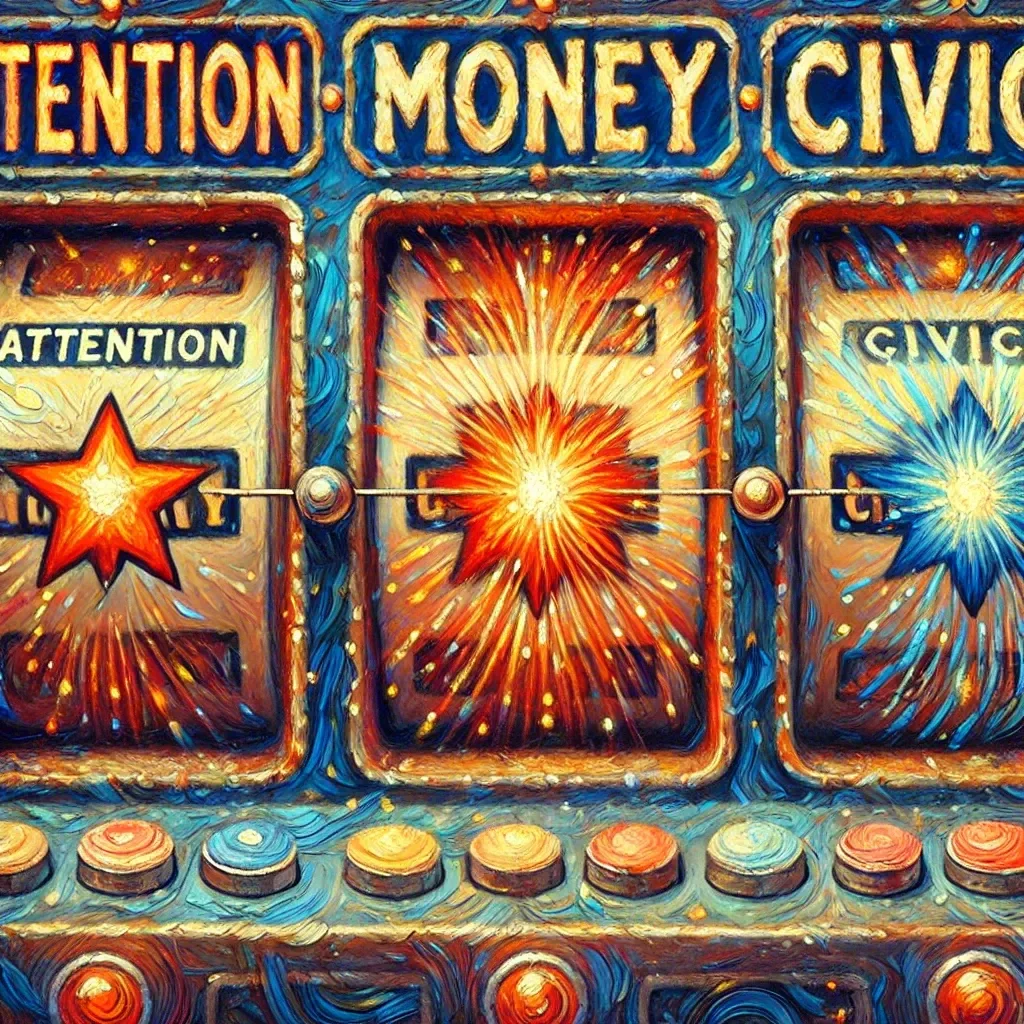
Every startup must achieve product-market fit to succeed. For social entrepreneurs seeking to scale media ventures to constructively engage and inform today’s fragmented citizenry, that is no simple task. In today’s all-consuming “Simulation” — an addictive media environment dominated by algorithmic feeds and friction-free distribution — civic media efforts must now compete in three very different arenas at the same time.
Enter the Three-Market Problem.
First is the Attention Market. In the era of modern social media, content competes in an endlessly scrollable feed governed by algorithms that reward whatever does the best job capturing and holding our gaze. It is widely understood that this environment rewards emotional and sensational triggers like outrage, fear, and tribal validation.
Next is the Financial Market. Even the scrappiest media venture needs a dependable revenue engine, yet audiences conditioned to expect “free” information typically pay only when they feel fiercely engaged. Converting audience buy-in into self-sustaining cashflow (in the form of subscriptions, advertisements, etc.) is therefore a race against the venture’s burn rate.
Finally, there’s the Civic Market. Citizens still need access to credible and relevant facts about everything from national social and economic issues to local policy matters (schools, zoning, etc.) to public health and beyond. This information is valuable but often not attention-grabbing (e.g. it tends to be nuanced, local, and sometimes technical) — precisely the kind of material that earns the fewest views and the least money.
Thanks for reading Civic Attention! Subscribe for more on building a digital world that works better for democracy.
Winners and Losers
Because each marketplace is powered by its own distinct logic, their incentives collide. The collision reliably selects for a particular winner: purveyors of hyper-partisan content and coverage. By leaning hard into ideological and tribal conflict, they feed the algorithm with the sensation it demands, gather a loyal and engaged audience around a specific set of highly polarizing issues, and monetize that loyalty through subscriptions, ads, merchandise, and more.
This model works across the political spectrum.
For example, by leaning heavily into culture war material, conservative media powerhouse The Daily Wire has grown a massive, hyper-engaged audience that pushed annual revenue past $100 million in 2022. Across the aisle, the anti-Trump MeidasTouch Network rode the same partisan momentum to #1 on Podscribe’s U.S. chart in March 2025, notching roughly 121 million monthly downloads and views and briefly supplanting The Joe Rogan Experience in the top spot.
Media ventures that can’t compete simultaneously in all three arenas wind up scavenging for scraps and the consequence is a classic market failure.
Information that fortifies democracy — rigorous, often nuanced, and vital to the majority of citizens — suffocates in algorithmic obscurity, while incendiary partisan ragebait surges throughout our feeds and replicates at industrial scale. At the same time, the rare piece of high-civic-value content that does go viral almost never converts into a dependable revenue stream.
The result of this market failure is the public sphere becomes overfed on sensation and affirmation and underfed on verified and actionable facts.
A figurative, AI-generated hallucination of the Three-Market Problem. Credit: DALL-E.
Designing for an Unfair Game
Navigating this imbalance won’t happen through wishful thinking, but two complementary tactics can give next-generation civic media ventures a shot at breaking through:
Serve the Simulation without surrendering to it: Package important facts in formats that algorithmic feeds can digest, such as short and pithy myth-busting reels, eye-catching swipe-through explainers, or references to current events in otherwise non-newsy pieces of content. Treat the Simulation as the top of the funnel by tying viral fragments to deeper off-platform sources of record where curious viewers can go to learn more.
Escape the Simulation’s gravity whenever possible: Own channels that no algorithm can throttle: email newsletters, SMS text lists, Discord servers, even printed periodicals distributed throughout in libraries, schools, and other public community forums. Media entrepreneurs must build audiences outside of the Simulation to reach them on their own terms, not the platforms’.
Neither approach fully resolves this entrenched and far-reaching market failure, but together they acknowledge that attention, money, and civic value trade on separate exchanges.
A robust venture that is designed to address the Three-Market Problem from day one — and understands that tradeoffs must be made to remain competitive in each — stands a fighting chance. One that ignores even a single market will keep colliding with invisible walls, no matter how noble the mission or viral the moment.