The social internet dream began with a bold premise: bring the relationships and passions that define us offline into cyberspace, and life will get better. Early Facebook embodied that vision: post photos from the weekend’s party, tag friends, relive the moments together online. As Jesse Eisenberg’s Mark Zuckerberg quipped in The Social Network, in those early days it was all about “taking the entire social experience of college and putting it online.”
In April testimony during Meta’s ongoing antitrust fight with the FTC, Mark Zuckerberg offered perhaps the closest thing we’ll ever get to a eulogy for that era of social media, conceding that “the friend part [of Meta’s platforms] has gone down quite a bit.” Instead, he suggested, his platforms have “turned into more of a broad discovery and entertainment space” where users consume a firehose of algorithmically-recommended content from third parties whom they likely do not already know or follow.
Meta’s own data is blunt: since 2023 (well into the decline of connection-based social media), the share of time users spend viewing their friends’ posts has fallen from 22% to 17% on Facebook and from 11% to 7% on Instagram.
Thanks for reading Civic Attention! Subscribe for more on building a digital world that works better for democracy.
How Discovery Ate Context
In place of social networking, we now have an immersive virtual slot machine operating at global scale with the sole maxim of commodifying our attention and selling it to the highest bidder (“the Simulation”).
To maximize its harvest of our attention, the Simulation needed a better lure than text and photos updates from friends and birthday reminders. The result is a new atomic unit of online expression: high-intensity short-form video clips. TikTok proved the format’s potency; every rival copied it. This shift has meant a seismic rearrangement of what surfaces in our feeds, much of which is:
Context-Free: A 12-second punch line or baby goat clip works without knowing the creator’s name.
Evergreen: A 1998 movie scene can outperform today’s news if the algorithm predicts you’ll finish it.
High Dopamine: Think jump cuts, big faces, bold captions, and funky filters that produce oversaturated colors. Each clip is engineered like a piece of digital candy.
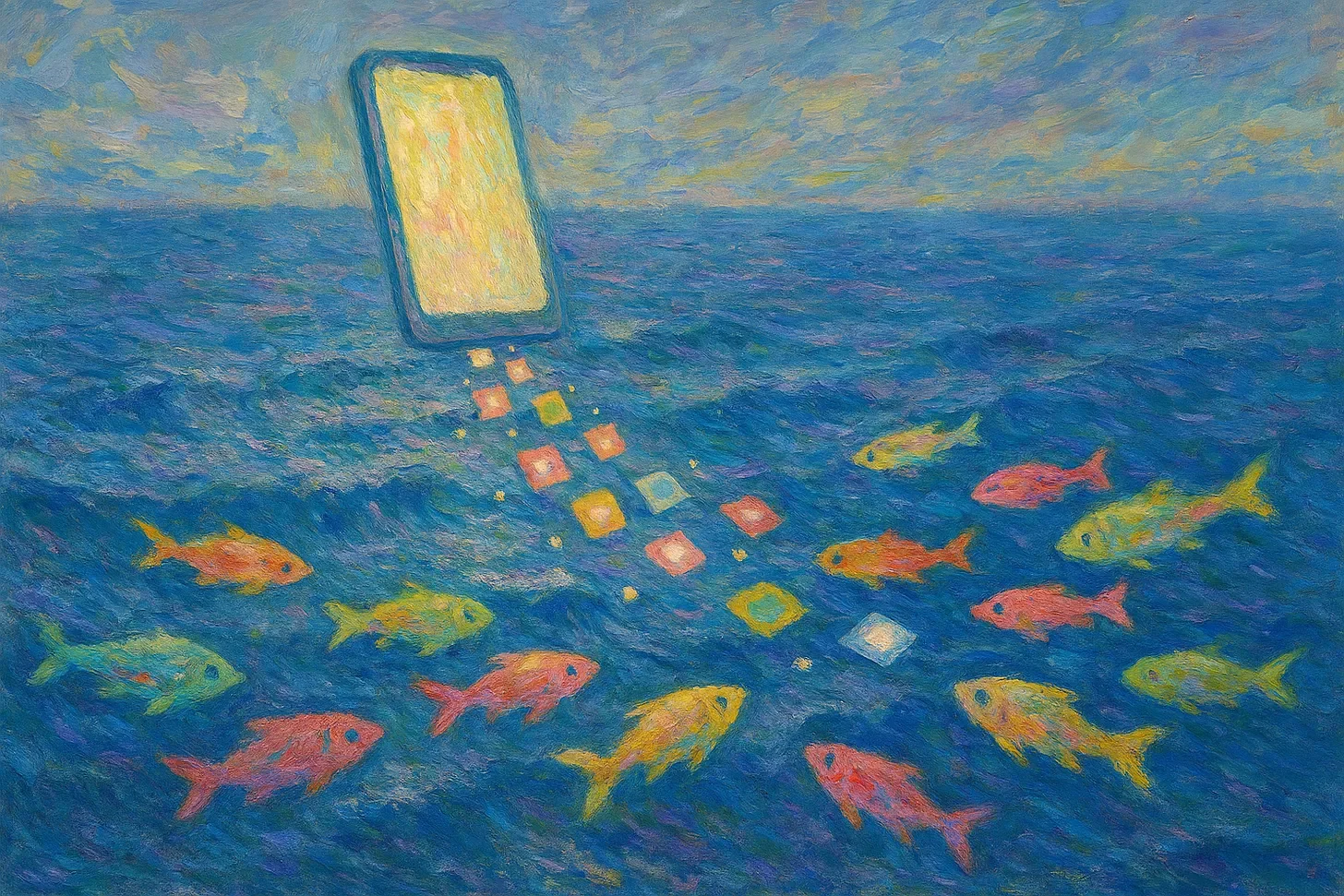
These clips are the digital equivalent of what fishermen call chum: irresistible morsels tossed into the water to bait a feeding frenzy. They often require little to no backstory to be understood, travel well across various niches and cultures, and, most importantly, generate cheap, reliable audience engagement. The Simulation sprinkles traditional ad slots between these chum buckets while also deriving value from a user base that takes the distribution work upon themselves — sharing, stitching, and remixing chum organically.
An AI-generated hallucination depicting a deluge of attentional chum. Credit: DALL-E.
When the Chum Itself Becomes an Ad
Enter the Australian crypto-gambling site Stake and its recent experiments in viral content marketing.
Open TikTok, Reels, or X and you may stumble upon a clip from a popular movie or TV show with a Stake logo alongside an even smaller #ad disclosure. The content features no formal paid placement, no link-out, and often no proof of licensing — and it has popped up everywhere in recent months. As Rolling Stone reports, the details behind this widespread campaign are murky at best.
Here’s an example:
A screenshot of a viral content clip on Instagram with Stake marketing overlayed at the bottom. Note the *72+ thousand* likes the clip has garnered.
Stake’s ruthless gambit, which appears to have performed incredibly well by standards of viral reach, is breathtakingly simple:
Hijack Existing Demand: Not only do nostalgic scenes from movies and TV shows already perform well algorithmically, but Stake often piggy-backs on pre-existing virality (the clips to which the company appends its logo have often already gone viral to some degree before). By baking the branding directly into the content, viewers can’t skip or hide it without skipping the viral material itself.
Let the Algorithm Do the Targeting for Free: Why pay to reach an audience when TikTok, Instagram, or X will algorithmically ferry each viral clip to interested viewers every time?
Reap the Organic Dividend: Because the promotions are not delivered by way of a formal, ad-specific platform feature, users encounter and consume the content like any other piece of organic content in their feeds.
Call it supply-side advertising: instead of purchasing targeted “inventory” between pieces of attention-grabbing content, Stake turns the content itself into the inventory — injecting its message into the chum before the chum ever hits the water.
What Civic Practitioners Can Learn
If a gambling house can inject its brand and message into nostalgic sitcom clips, what’s stopping bad actors from smuggling disinformation or extremist propaganda the same way? The Simulation’s economic engine has no built-in brake and every new tactic that reliably boosts viral reach and retention is almost guaranteed to become a common part of the digital marketing playbook.
So where does that leave educators, journalists, community organizers, and anyone else trying to strengthen democracy and civic engagement online?
Embed Civic Signal in the Chum: Civic practitioners can and should take lessons from the way Stake has leveraged organic viral distribution to get its message out and would be remiss not to explore creative, ethical, and copyright-sensitive ways of doing so in service of the public good.
Build Community Infrastructure Outside the Simulation: Ultimately, healthier discourse requires spaces that value deliberation over attention fracking. Private group chats and community Discord forums, paid communities like newsletters and Patreons, and open-protocol “fediverse” platforms like Mastodon (and, somewhat surprisingly, Meta’s own Threads app) all offer models where user attention isn’t the sole currency being exchanged.
Teach Algorithmic Literacy: The more citizens recognize chum for what it is — bait, not food — the better chance they have of deciding when to bite and when to keep scrolling.
The Simulation’s appetite for attention is infinite; our challenge is protecting our autonomy by refusing to feed it on autopilot.
By blending high-quality civic information into formats the algorithm already rewards, reformers can do their part to reach massive audiences on the platforms themselves with need-to-know facts and dialogue. But the long game must be cultural: forging spaces, norms, and business models that treat our attention as a critical resource worthy of protection and cultivation, not a strip-mine.