
In June, we explored how the results of a recent Civic Attention survey with YouGov indicate a growing “attention rebellion” among today’s young adults, who are the first generation of Americans to forge their civic identities entirely online. As we wrote then:
“Young adults feel the grip of digital addiction most intensely, depend on social media for news and community most heavily, and voice the loudest call for healthier and more deliberate online habits. As we have argued before, the answer to the challenge posed by modern social media must be a pragmatic middle way between the polar extremes of ‘Onlineism’ (the status quo for far too many of us) and ‘Offlineism.’ In the quest to achieve a healthier attentional equilibrium, young people are likely to lead the way.”
In order to better understand the nature of this brewing attention rebellion, we conducted an analysis of our survey results with the goal of learning more about the Americans most likely to lead it. What we found is a segment encompassing roughly one-quarter of the adult population — a group we like to call “Attention Populists.”
Attention Populists are defined by their strong interest in building better habits around social media and their acute skepticism of the addictive and manipulative tactics of platforms and algorithms. And they may well be the tip of the spear in a cultural and civic movement to reclaim our agency over our attention.
Who Are the Attention Populists?
Attention Populists represent ~23% of the U.S. adult population.1 While not confined to any single demographic, their profile diverges from the national average:
Attention Populists skew younger. Their median age is 39 vs. 48 nationally.
They are more racially and ethnically diverse. 61% are white, 15% are Black, 14% are Hispanic, 3% are Asian.
They are more highly educated. 41% hold a four-year degree or higher vs. 33% of the general population
They skew ideologically center-left. 38% liberal, 30% moderate, 24% conservative, 8% unsure.
Attention Populists cut across age, race, geography, and ideology. But their defining feature is not who they are demographically but what they believe about the current attention economy, what it’s doing to us, and what should be done about it.
Attention Populists are heavy social media users — and heavily dissilusioned about their experiences online.
They rely most intensely on the digital environment while simultaneously being the most dissatisfied with it:
Six in ten (59%) Attention Populists spend three or more hours per day on social media, compared to 45% of the general population.
Two in three (65%) consume political or news content daily, compared to 55% of the general population.
They report greater happiness from social media than average (35% vs. 28% of the general population), but also far higher rates of stress, anxiety, and hopelessness (53% vs. 35% of the general population).
Two in three (67%) say most of what they see comes from influencers rather than friends and family (vs. 52% of the general population)
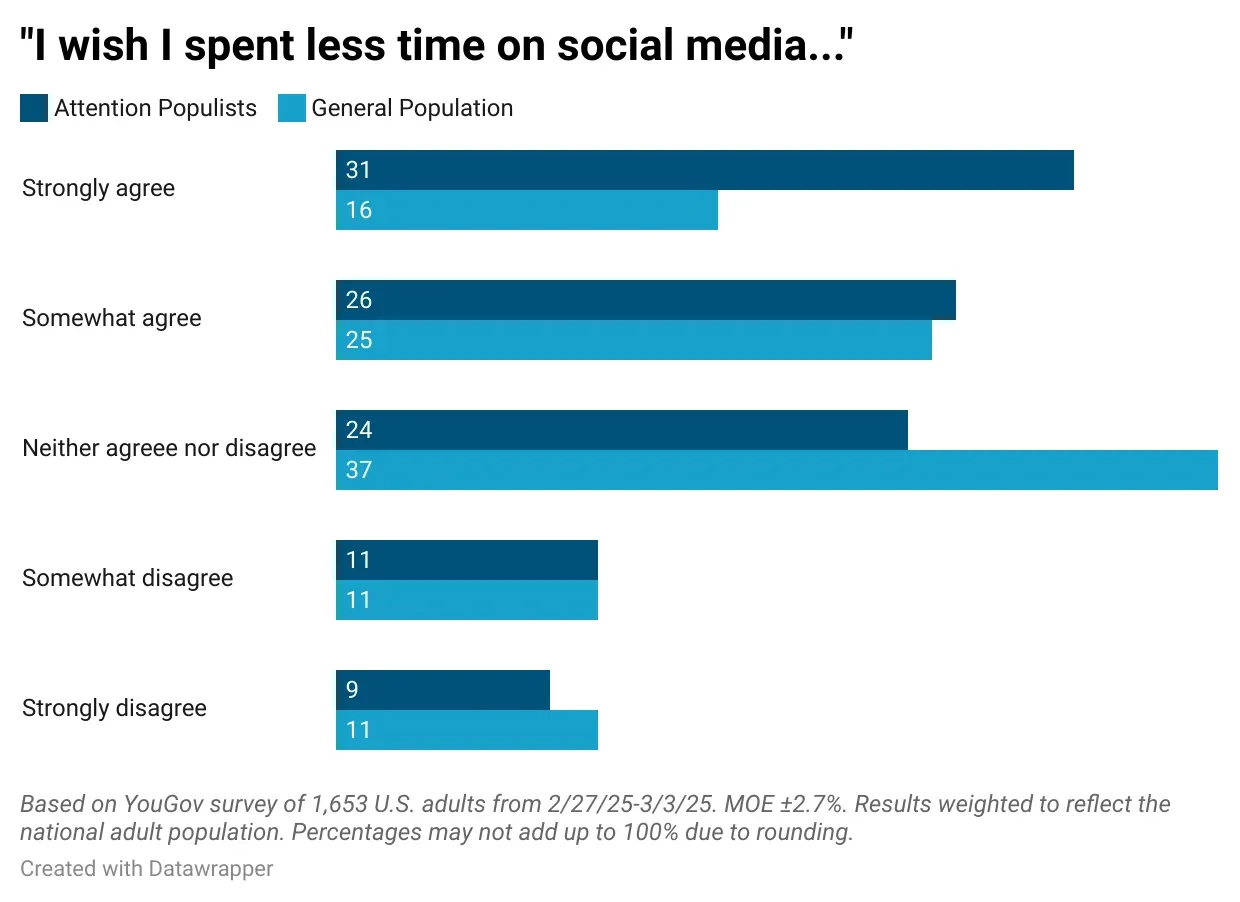
A majority (57%) wish they spent less time online, compared to 41% of the general population. Over one in three (36%) describe themselves as addicted to social media (vs. 21% of the general population).
Attention Populists are much more sensitive to the individual and social consequences of social media.
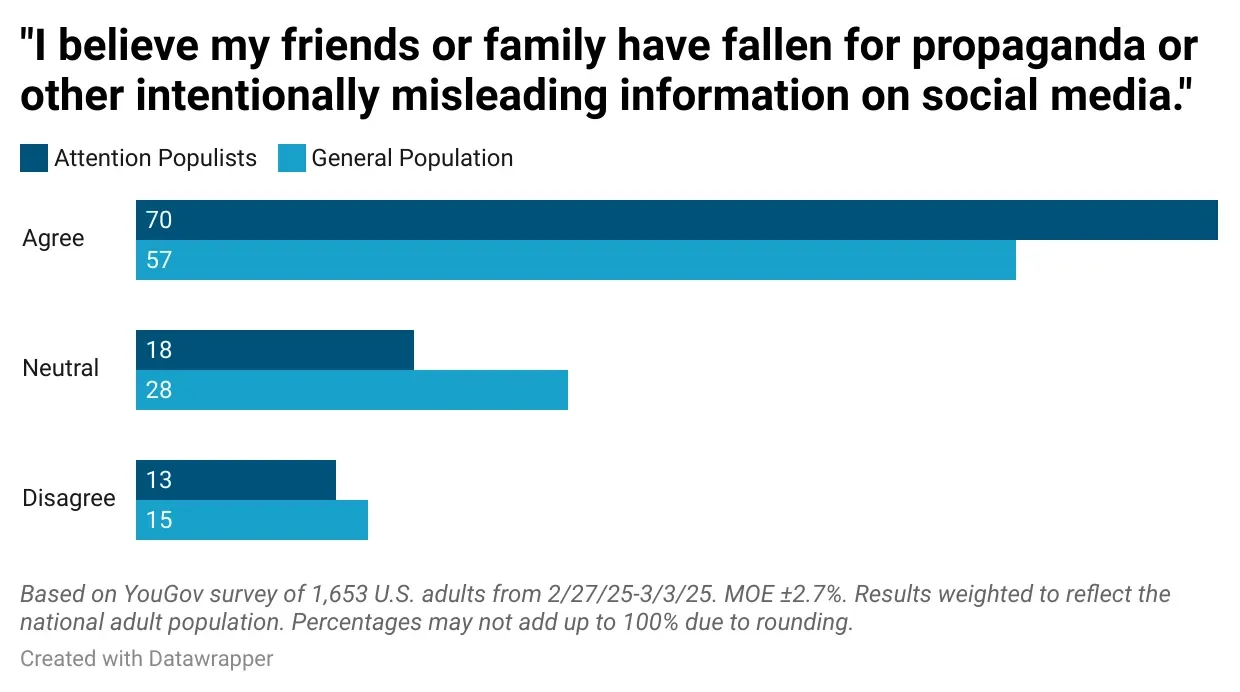
More than two in three (70%) Attention Populists say that their friends and family have fallen for propaganda or misleading information on social media, compared to 57% of the general population.
They are also more likely to acknowledge that they themselves have fallen for propaganda or misleading information online (41% vs. 27% of the general population).
They are significantly more likely to view social media’s impact on individuals and society as one of the most important issues of the 21st century (60% vs. 28% strongly agree).
Attention Populists have the strongest appetite for change.
If there is one hallmark of the Attention Populists, it is their desire to reform the system in a direction that more strongly respects our attention and agency. Compared to the general population, they are dramatically more likely than the average American to:
Want to adjust their own social media algorithms in order to have more control over the kinds of content they are shown (65% vs. 37% strongly agree).
Seek to build better habits around their social media usage (64% vs. 14% strongly agree).
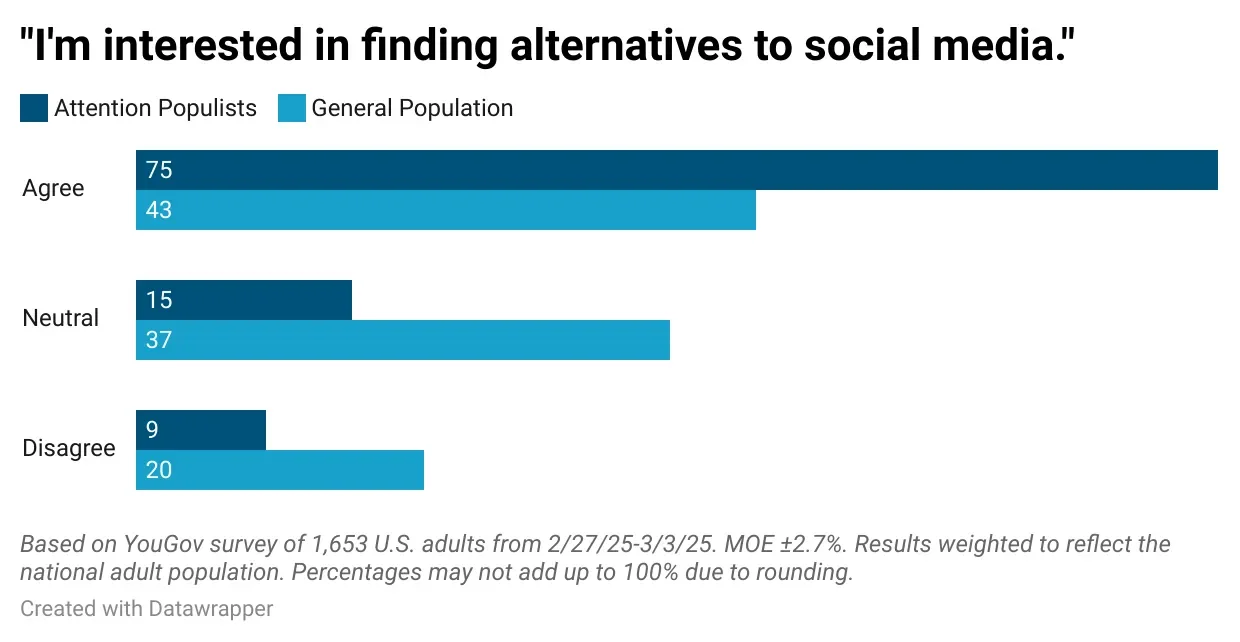
Express interest in alternatives to today’s dominant social media platforms (50% vs. 16% strongly agree).
Attention Populists vs. Attention Aristocrats
We have written before about the transformation of social media from a casual and endearing space for socializing with friends and family into an addictive, all-consuming entertainment environment we call the “Simulation.” We’ve also discussed the rise of a new class of “Attention Aristocrats” who, in exchange for the kind of dopamine-inducing content that keeps us scrolling endlessly, reap the full benefits and rewards of the Simulation and its incentive structure.
If the Attention Aristocrats thrive by shaping feeds and commanding influence and attention, the Attention Populists stand in direct opposition. They are skeptical of the platforms’ motives and impacts on us, hostile to the influencers who dominate our feeds and sell us products, and vocal in their demand for reforms and alternatives.
Where the Attention Aristocrats accrue vast amounts of wealth and status from our corrosive modern information environment, the Attention Populists are those most disillusioned with the Simulation and most motivated to challenge it.
The emergence of the Attention Populists suggests that dissatisfaction with the digital status quo is not diffuse or passive. It is concentrated in a large, diverse, and increasingly vocal block of Americans. These are not casual critics who bemoan the Simulation from the sidelines: they are daily users who both depend on and resent the platforms, who feel both connection and corrosion at the hands of the Simulation, and who are urgently looking for more balance and control over their attention.
The Attention Populists are ready to revolt against the addictive and agency-eroding trappings of the modern attention environment. The only question is whether a new generation of cultural and civic leaders will rise to meet them — and the moment.
For more information, check out our full survey memo and view toplines and crosstabs here.